Föld Theatre is organizing an international community specific workshop from the 5th until the 19th of August in Roşia Montană (Romania). The village is partly abandoned, because a Canadian company wants to open a gold mine there. On the blog you can find a log-book written by the participants, photos and other background information about the project.
The village is in an interesting situation. More than half of its population, about 600 people left in the past years. A Canadian-Romanian company, Roşia Montană Gold Corporation intends to create one of the biggest gold mines of Europe on the place of the village, so they offer houses in Alba Iulia for the inhabitants of the village.
Roşia Montană is strongly present in the media, but only regarding ecological, economic and social problems. We on the other hand are interested in the people who live there, in their dreams, their fears and their everyday life. How do they handle this uncertainty that has been going on for years? What makes them stay in the village even though a Canadian company offers them an apartment in the town of Alba Iulia? How do they imagine their future?
The research of the local community and the communication with them follow some anthropological and ethnographical principles; one of them is that “you can get if you give”: by organizing common events – bonfire, film projection, playing music – on one hand the life of the village becomes more vivid, on the other hand people open up more, if they don’t feel like some kind of spectacularity, but part of a natural, mutual communicational process. The research partly proceeds by interviews with the help of interpreters. The interviews do not focus on the mining project, most of the locals are already fed up with reporters and tourists, who are willing to know only that – but they open up much more, if they are asked about their everyday life, childhood or their future.
The workshop goes on parallelly with the similar research of the Romanian „dramAcum” group, who are also collecting materials at the place for their play about the actual social situation of Roşia Montană, which will be presented in Cluj Napoca in November.
The initiative makes part of theatrical trend that involves outsider groups (for example a village) in the work, and with this and fieldwork it examinates actual social phenomenons with theatrical tools. Therefore the raw material of the production is not a pre-formed text, but the experience gained there about a heterogeneous and complex reality. This material is continuously changing, „boiling”, and never can be percepted in its wholeness. This uncertainty is inspiring: it strongly stimulates the experimentation with expressing tools of the theatre.
2010: graduated in Literature and Aesthetics at Eötvös Lorand University, Budapest
2009-: editor, Scolar Kiadó
2008-: member of Föld Theatre
2007-2008: improvisation course on the role of "Clown", Trento (Italy)
2006, 2007: leading theatre workshops in children camps
Since October 2009 - Project assistant, Krétakör, Budapest Hungary
Since September 2009 - Artistic manager of Bakelit Muti Art Center, Budapest, Hungary
Spring semester 2009 - Teaching acting for adults at Melchiades Group, Budapest, Hungary
2008, 2007 - Organizing and leading several international theatre workshops in Denmark and in Hungary (final performances made at Vestjyllands Højskole, Denmark; Hantos and Merlin International Theatre, Budapest, Hungary)
Fall 2006 - Teaching drama for 7 - 8 years pupils, Prím Art School, Budapest, Hungary
Since 2004 - Leading the ensemble of Föld Theatre, directing several performances
Workshops led by him
August 2008 - “How beauteous mankind is” - international theatre workshop, Hantos, Hungary
April 2008 - Body and Space - theatre workshop for the students of Vestjyllands Højskole, Ringkøbing, Denmark
August 2007 - The Journey of Odysseus - international theatre workshop, Hantos, Hungary
February - May 2007 - The Homecoming of Odysseus - for international students of Højskole, Ringkøbing, Denmark
2007: Vestjyllands Højskole, theater workshops
2007: International Theatre Workshop at Hantos, organized by Föld Theatre
2008-2009: Academy of Untammed Creativity, Coppenhagen, studying circus art
2007: Vestjyllands Højskole, theatre workshops
2007, 2008: International Theatre Workshop at Hantos, organized by Föld Theatre
2009: Theater in Education programme at the University of Cape Town, South Africa
Today was about preparing and realizing the bonfire. After breakfast we went up to the Unitarian church, where we started with physical training the day. After having warmed up our body parts, we warmed up our voices too, and at the lake all morning we were practicing some Hungarian and Danish songs, all the mountain resounded them.
All of a sudden the noise of a car interrupted the music, a policeman stopped by, who told us with our invitation card in his hand, that we cannot hold the party in the evening, if we didn’t arrange the police, the ambulance, and even the firemen for the venue. The communication was not easy, because none of the interpreters were there with us, and the policeman could only talk in Romanian. So Bálint had to get into the car, and go down to the interpreters. Thanks God, with their and Sorin’s and Csongor’s help we got the permission for the evening. After the singing we split up in groups, some were collecting woods, and we started to prepare the most important part of the evening: the game machine.
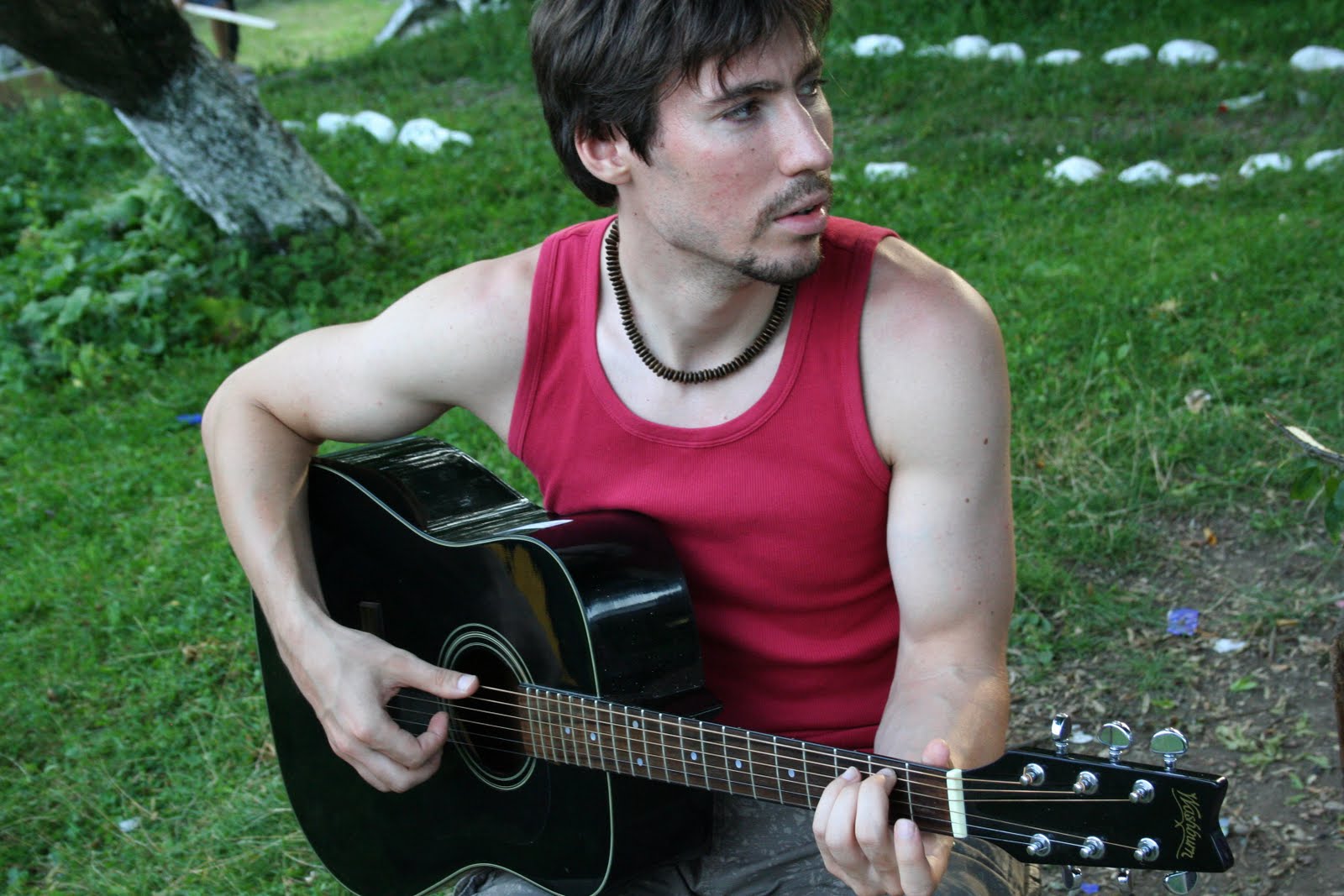
About six in the evening the guests started to arrive (we tried to invite as many of locals as possible). Andrei was already baking the Romanian sausages called “mitches”, some of us were preparing the bonfire. We served wine and talked with the guests, sometimes only with arms and legs... When enough people have arrived to the lake (we were quite a lot, and some of the locals opened even a little bar, they were selling drinks), first we sang a Spanish song, “El Cantante”. After that the game started. The volunteers could play “rock-scissors-paper” with Fanni, or “pen to the bottle” with Esther (a pen was hung on the waist of somebody, and he had to put it in a bottle without using his hands). Laila, Andrea and me put our faces into the wholes of the paper boxes that we had prepared, so in the machine. If the volunteer won in one of the games, could push the arm of the machine (Andrea’s arm), and after shaking a little bit our heads, we made a smiley, a sad or a surprised face. If we had the same expressions, we gave a song, a circus attraction or an evil trick... In the beginning the guests came a little bit uneasily to play, but after a while the machine started, and I think they really enjoyed playing together. When we finished with the machine, in the rest of the evening we served mitch, we talked to them and played music.
Really a lot people gathered there this evening, and I really enjoyed that we are so different in nationalities, in the age or in our interests. Rózsika néni came, who was happy to talk in Hungarian, Zénó bácsi was giving us palinka with a huge smile on his face, Kornya who, as usually, sang to us.... After we left the lake, we closed the evening in the pub in the square, playing with children, drinink with the actors from Cluj and some locals. (Szenteczki Zita)
Arrived yesterday after a day and a half of travelling. Everybody’s busy this late afternoon so I went for a walk. To grasp the situation of Roşia Montană, I picture the village as a person, her story as a life story. I see houses falling apart and new houses being built, an uncertain future that is unspoken, a resource that has become a threat to her survival.
Again today the group starts with the physical training, I spend the morning reading and hurrying to take a cold shower while there’s not a line of people waiting. For hot water we need to first light a fire in the oven in he courtyard.
They are just finishing the training when we join them. We are asked to write down questions, in silence, anything that comes to mind. All, I think, are wondering why. On the way to the church a few minutes later, Bálint is carrying a chair that we will use for something
The chair is thoroughly tested for durability. And then we are told the task: working in pairs, one goes to the floor and must all the time keep moving, staying connected to the chair and answering the questions put forth by the partner.(see the photos)
Questions are banal, emotional, intriguing. It’s great to see how people invent elegant moves, awkward postures and fine balances with the chair; and curious how much easier it is to make fresh and humorous answers when there is this distraction of movement. It seems one can communicate much more straight-forward in this manner; maybe Freud should’ve thrown out his divan for some floor space and a chair.
Tomorrow we are inviting the locals to come to the lake further up for a bonfire, music and games. Finishing the preparation for this event, we work in two groups to come up with ideas for the evening’s programme.
Lunch.
Music in the church. The elderly woman who was to teach us some folk songs, never appears, she was too tired when they went to pick her up. But we rehearse some songs we know already, and that resonate well in the small church, where the priest must perform all duties from giving the sermon to playing the organ, even when the church is empty of people except for this servant of God.
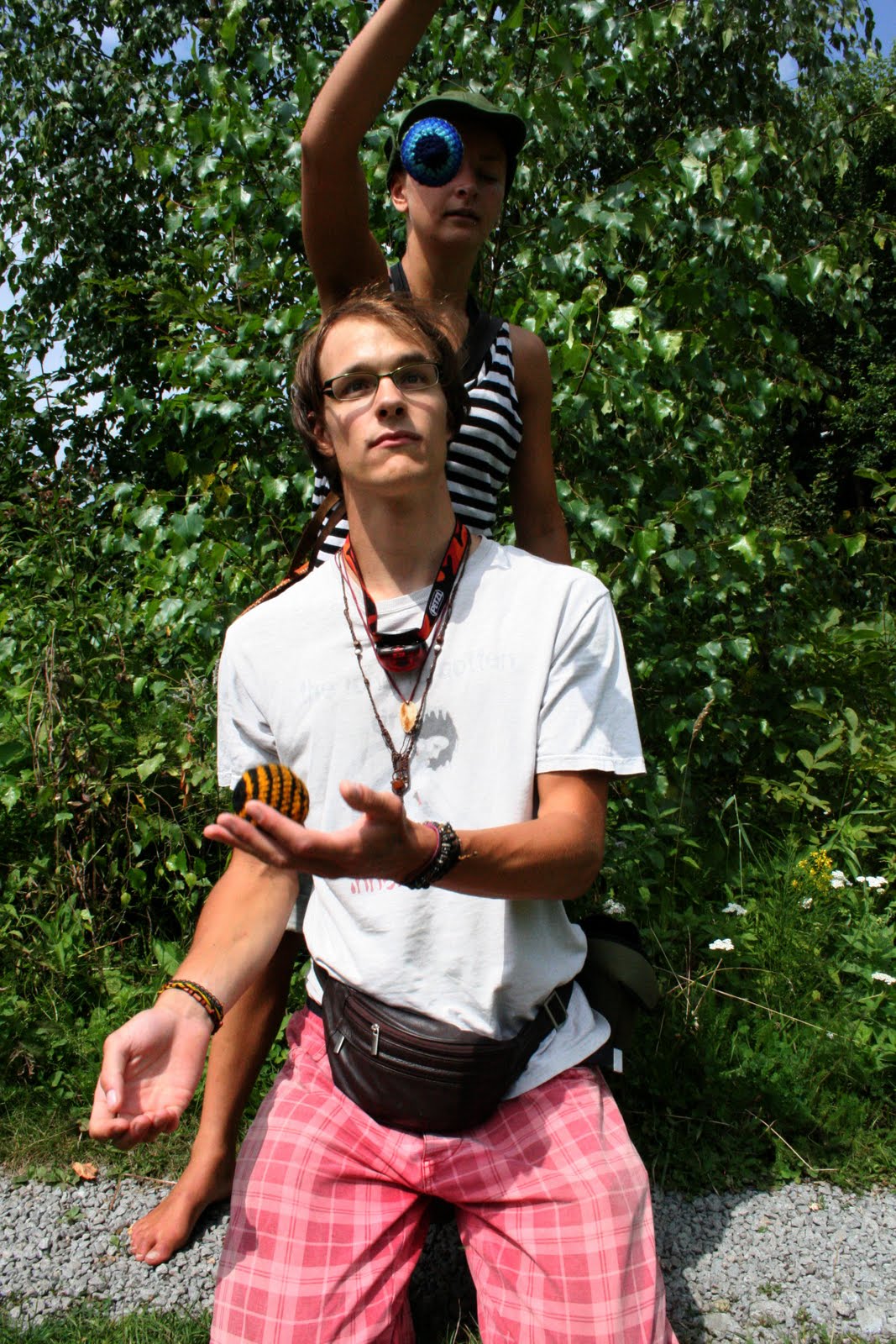
Instead of learning the new songs both groups present the mornings work. The first group has written down a load of ideas for games and spectacles. The other group presents a living one-armed robber: three faces next to each other, framed by carved cardboard boxes. Three identical face expressions cash out a small performance..
Then it’s time for the guided tour of the upper village. G. is Hungarian, employed by the Gold Mine Corporation and, as happens, married to the chief architect of the corporation. Mocking the fools who splashed cement on the old stone walls, (causing the wood to rot and the stone to burst, because the water cannot pass through the material), he takes us from house to house that is now property of the corporation. They all need restoration, many of them are supported by wooden beams. The cement has been taken off the walls, revealing straw nailed to the surface to catch the plaster. His comments are full of film references and slang, Fanni does a good job translating. Some questions are not really answered.. in the end nobody really understands the logic of the restoration project. Is it to get goodwill, to appease opponents?
Dinner. Discussion about the evening and about tomorrow.
It’s dark and a little chill, it is evening. Right now S., our host is screening film in the small square outside. Quite a few people have turned up. Chatter from the courtyard. How many of the locals will come? People start going to sleep. Goodnight, goodnight. (Anna Laursen)
I am sitting for myself at the dinner table in S., our hosts yard, starring aimlessly out into the air in front of me. Around me, people are moving, cleaning their plates, talking, laughing, drinking their tea, and I just sit here and stare. And Bálint asks me how I feel. A perfectly normal question I guess, not strange in any way – perfectly natural. In any other situation it could be a throw-away enquiry, made mostly out of politeness, but here, now, there’s much more to it; the words that form in Bálint’s mouth has a special ring to them, a concern playing in the spaces between the letters. Today it is three days since I arrived in Roşia Montană, coming directly here from travelling Italy, not really knowing what to expect, and without knowing anyone but Bori, that I met two days before. I had only met Bálint once before and had no experience at all with The Föld Theatre, this kind of workshops, and actually, very little experience with acting in general. And here I sit, starring. What do I think about? What’s going on inside my head?
Today we started doing acting-stuff. And what better place to start doing your acting stuff than at the church? So we went to the church, first thing after breakfast. The Unitarian one, not the greco-catholic, or the orthodox, or the normal catholic or other orthodox one. And we started the warm up. Now, I have been in a church a lot of times in my life, but never had I thought I should be playing around like this in a church, and yet, here I was, standing with my eyes closed, in front of Laila, making all the weird noises I could stretch my mind to think of. Here I was, sitting on a church bench, improvising song over the chanting of the others of the group. Here I was popping up from my hiding behind a bench, to start singing a Romanian children song that I could not pronounce the words of. Here I was, within the rein of the Roşia Montană Föld Theatre.
I really need to learn Romanian. Really. Our translators are doing an amazing job, but seriously, how can you hope for people to pour out their dreams and hopes in front of you, when you can’t even tell them bless you, when they sneeze. But of course, I didn’t find the time for Romanian lessons today either. I guess I have been trying to find the time for three days now, but nope, still no success – all I have learned is yes, no and good day. You can have all the good intentions in the world, but it will do you no good. Time is a luxury here in Roşia Montană. When I first arrived, I decided to write a bit every day about my experiences. Helps to process everything. Helps you realizing what you have learned. Helps me stay sane. Okay, Morten, now really? Well, apart from it being hopelessly naive of me, to believe that I could actually manage to write just a bit about a whole day in Roşia Montană, the time, when nothing you for all in the world would want to be a part of, is not taking place, doesn’t exist. It is always there. Whether it’s doing a headstand, building a tower out of people or learning an Argentinean song, it’s always there.
There are so many interesting places here. It’s like in a fairy tale. Like something I have only ever had the pleasure of imagining. But it’s all for real here. The mountains, the woods, the cows walking around in the streets and the abandoned houses. And the abandoned houses. Right here in front of me, Roşia Montană stretches out like an enormous playground.
We were playing today. The kind of playing that’s still so very new to me, but seems to be perfectly natural to the others. Dividing into three groups and with the only instructions, to dig for an experience in our memories, that seemed to us, parallel to the events taking place in Roşia Montană, we went out into this grand playground, to make some kind of scene to present to the others. It’s an enchanting freedom; having nothing restraining you. And yet so scary it is, to have to stare hard into the void of your own imagination until something forms out there; something you can catch and tame, and then throw it out into the light of the world. But enchanting it is. Hours of exploring and adventuring in an old abandoned house, imagining how the inhabitants had walked around and packed their stuff, preparing to leave and arguing about, if they should bring the old sofa. And then, to transform the whole thing into theater... Not the worst way at all to spend your afternoon, I’d say..!
So what am I thinking sitting here starring out into the air? What is going on inside my head? Am I feeling alone, alienated, insufficient, homesick? I am seldom feeling so much at home as I do here, so satisfied and happy with how things are. No.
I am not sad.
I am the incarnation of all of my experiences. The sum of the storm of things happening all the time all around me. Of constant adventure and the impressions left by wondrous places. Of 13 great persons exploring the unknown with me, and putting all of themselves out there in front of me and into this project. I am a product of staying up late yesterday night: talking, playing, drawing; the day before: reading Danish folktales. Of the sheer multitude of new things tried and learned. Of physical training today – hard physical training and acrobatics... Learning to build a tower out of people and to stand on each other’s shoulders. I’m not sure I have ever learned so much in such a short time in my entire life, and I am wasted.
Bálint asks me how I feel. And I turn to him and tell: Tired. (Morten Andersen)
2009: 3 months living in a theater in Bolivia, participating in various workshops and making theater sports-workshop for kids
2010: „Teater and social justice” – course at Malmö University
In the morning the group of Laila, Esther, Martin and Diana went to see the Gypsy whom Bálint and Zsófi already met. He talked about how he found God, about the bad relationship with his wife who drank too much and cut herself. He wanted a new wife. He played the accordion but didn’t have an instrument. He was in a good relationship with the priest who gave him cigarettes. But sometimes only half a pack so that he will work because he always had a break when he smoked. Then they spoke to the Orthodox priest who was 39. He just won a trial and with it the right to build a church. He was scared that they were from the press and publishing unreal information. He invited the group to have from his home made palinka. He built the main part of the church from his own money. He was the son of the priest. It wasn’t good to be the son of a priest in the army. In order to avoid this, he studied theology and law. His wife is a schoolteacher. He would like his son to study theology but will not force him. When he lost his church, the people of Roşia Montană helped him a lot. He is trying to repay them this loyalty. He cannot say for or against. He said that the situation is very uncertain.
On the mine trip the joined group of Bálint and Diana went on a mine trip. Their guide told many stories, for example about the man, who was pretending to be very rich by putting stones in a sack an some gold on the top of it, and he hide it in a room. Since he was also all the time visiting the doctor, everyone thought that he is seriously ill. So this way he got five wives – all of them died in the same way: they searched for the sack, and when they found the stones, they got a heart attack. The weirdest theory that we’ve heard of him is that the Corporation is not there for the gold but for the uranium and the plutonium and they are cooperating with the NASA). (Hinsenkamp Fanni)
We made some interviews today in groups, I was with Andrej, Andrea and Bence. On the way we said hi to the man with the two cows who worked in the mine as a driver 40 something years. We had an interview with him yesterday. After a big hike up the mountains we found somebody in a garden. We asked for directions. Soon a man came there and we had a chat with him. The view was breath-taking from there. The windows of the house looked upon the hill where the remains of an ancient volcanic eruption formed huge rocks with caves. He came to Roşia Montană when he was a child. He has lived there ever since. He is Hungarian, but cannot speak Hungarian. I guess at that time the Hungarian school and library was already closed. He is retired. He worked at the coal mine in Petrila and then he worked at the copper mine nearby as an electrician. We asked where he played with his friends when he was a child. He showed the mountain with the rock and he said that they were making bombs from carbide as children. Nowadays he goes drinking with friends. He said that he doesn’t know any songs and people don’t sing in the pubs anymore as in the days of his parents. He would like to remain there for the rest of his life if he is not obliged to leave by the Gold Corporation.
Then we did some climbing we had to do to get up to the lake. The cow stamps were showing us the way. The lake was surrounded by grassy hills, with some cows here and there in the distance. We discovered two figures on the hill nearby. They were cutting grass. Sitting on the hill, watching the beautiful view of the lake and the hills, I sometimes got lost in the long long legend of Roşia Montană. The story started some 6-700 years B.C. with the Daks. When the Romans learned about the gold of the area they came to occupy the land. The famous Dak character has managed to change the river`s route, and the people hid their treasures under it. But a traitor told the Romans where to find it. It seemed that the man labels people easily as traitors. Those that have left Roşia Montană are not his friends anymore. There are three things you cannot sell – told us: the house of your parents, the church and the cemetery. We walked down together and he invited us for palinka and coffee. His wife came home too. We got to know how they met in the school and how the man asked her wife’s hand in the 10th grade very simply. The woman’s nickname was Mici. She was always complaining to her mother when she was a little girl, because the donkey in the street was called Mici. The donkey belonged to a man, who was a strongman His story was funny. He didn’t speak proper Romanian. Once he took the little train from Turda to Abrud and the driver asked: “Kobor....?” Which means: Are you getting off? Since “Kobor” was also a family name in the region, he said: no, no, my name is not that. And he missed his stop. After he never took that train again. Under the influence of the sweet palinka with fruits it became quite difficult to communicate in Romanian, Hungarian, English and Italian. “Parlamento!” – said the man to the confusion. We all became very excited. Personally I had to stand up and clap every now and then because of the adrenaline. The couple was open to any questions. They are willing to participate in our play. They won a theater competition in the region when they were in the 8th grade. They started to teach us a song and tomorrow we plan to sing it together on the main square. The woman also agreed that Anikó and Máté can shoot how she is singing while milking the cow. She was worried that she will not be able to see us if we have our performance around 19, because that is the time for the evening milking. (Hinsenkamp Fanni)
7:00 Bálint, Zsófi and Andrei got up to meet the major to discuss about renting the community house for the rehearsals.
9:14: Breakfast is ready, Bálint, Zsófi and Andrei are waiting for the major.
10:00 Meeting, we go together to the community house, where we can see a short presentation about traditional female clothes.
11:15: Physical training led by Fanni; weather: sunny, there are a few clouds, running is difficult up to the lake, Bálint, Zsófi and Andrei are waiting for the major.
12:17: Gathering on the terrace, task: find interesting places in the village.
Personal note: after 900 m to North-East I reached the edge of the village, 80% of the houses are abandoned; on the right of the road I found an opened wooden house: interesting place for rehearsal. After I left the village, I found some falling rocks. I didn’t find any gold.
14:50: Lunch is ready; Bálint, Zsófi and Andrei are waiting for the major.
16:00: Gathering and short presentation about the morning task, making groups, interviewing the locals. Storm clouds appear above us.
Personal note: It’s hard to discuss about the food, a simple shopping list makes a huge flow of words, after explaining for quarter of an hour, we manage to agree that they bring us 8 kg of bread. Acquisition of vegetable and milk products postponed.
19:00 Playing music on the street – rather an opened rehearsal on the street. Bálint, Zsófi and Andrei are waiting for the major.
20:10: For the reason of raining street music adjourned, Bálint, Zsófi and Andrei give up the waiting.
20:30: Dinner is ready, after that presentation of the evening task
21:30: For the reason of rainstorm presentation replaced to the inside
23:00: The planned projection is postponed, retreat
Roşia Montană lays about approximately 450 kms from Budapest (by car). We had a stopover in Cluj which made the journey even a bit longer. Cluj is the largest city in the area of Roşia Montană; and we were hosted there at a charming family. Ferenc, the father is a professor of Ethnography, we got the contact of one of his daughters, while we were looking for interpreters. Viola, the daughter promised us, that she will find someone for us, who will help with translating on our visit. Finally we didn't just get a help of a young Ethnography student, but the family hosted us in their appartment, and we were offered several affluent meals, crowned by a diner cooked by the academic of the family.
Next morning, after meeting with our hosts and having a wonderful breakfast at them we set out for Roşia Montană with Tamás, the ethnography student, and with a load of infos from Ferenc.
Tamás had been to the village several years ago. He had some preconceptions about the situation in the township, as probably the majority of the Romanians does. It has been a permanently returning media issue for them in the last decade. For me one of the greatest experiences of our short visit was seeing Tamás's point of view smoothly shifting, how it became more particular after talking with more and more various people from the town. He even stated himself, when we were leaving the village, that he had a different image at the beginning of the day.
It just started raining when we arrived. We immediately discovered the pub, which is special mixture of a private and public space. I had the feeling the proprietors had turned their living room into a bar. I have seen an amazing painting, showing a transparent pelican, through which you see a naked couple sunbathing on the seashore.
We set down in a circle of middle aged men to have a coffee. I asked Tamás some sentences in Romanian in order to try to trick a smile on the face of the quite crust bartender lady. I wouldn't say I made the biggest success of my life.
After the coffee, we decided to start our discovery tour nevertheless it's raining.
It became clear: looking for accommodation for a group is a good way of making contacts in a village. Or maybe it's even a bit more accurate to say searching for 'Eugene' is a good way of making contacts. Roşia Montană lays in a valley of two hillsides. It is rather steep, which means going from one end to another is either a descend or a good climb. Our first discussion was with some youngsters who run a hostel at the entrance of the village. They mentioned that Eugene runs a similar hostel but with larger space. And after this point trying to find him, we went up and down on the hillside. It seemed everyone had a different conviction about where Eugene lived actually.
Finally we have found his house a little bit outside of the village at the end of a road, where we have tried earlier, just gave up when the road left the houses. By that time the rain stopped and the sun was about to set.
While searching for Eugene we met with several captiving figures of the village. We saw the wonderful pond above the village, abandoned houses, and some others, when it was difficult to decide whether there lives someone, or not. It used to be a very elegant village. Gold-mining was a well-paying job. Now the one-time elegance melts into the beauty of ruination. We also considered to visit the ancient mine from the Roman age, or the museum in the center established by the Gold Corporation. (Apparently they invest a lot of money to preserve or even create an attracting outfit for the township.) I was strict, and said we should rather aim for our goal: making contacts and finding accommodation. So we left these adventures for our common time there...
There are so many different situated people living there, and all of them had time to talk with us. This is how we found our accommodation as well.
For me the greatest thing in this visit was the simple experience of having success all the time when we initiated a conversation. I find great challenge in starting a contact with a completely unknown person. And our visit revealed for me Roşia Montană is offering us a lot while we intend to experiment with this. I think a theatrical encounter goes the same way as an encounter of two persons, just in a larger scale. One has to take the initiating role (the first step) in making the contact and the next person will open as an answer for this. Typically the actors are the ones who will initiate, and (if it the start is sincere and strong enough) the spectators will follow. While doing this as theatre, I hope we develop in our human relations. I hope we will understand and undertake the challenge one always has to take to role of the initiator.
A short visit in May to start preparing the workshop. Her you find some first impression that we had when we`ve seen the place.
Participants: Bálint, Zsófi, Attila (driver), Tamás (interpreter)
See photos at: http://picasaweb.google.com/juhaszbalint/RosiaMontana#
You can not be in Roşia Montană without knowing about the Gold Corporation and the mine issue, even if by some surprising circumstances the information wave of the media avoided you. First of all, there are the mountains with pieces missing here and there. The actual mining of gold hasn’t started yet, but there are parts of the mountains bit off, maybe for taking samples or for marking the area.
There is not a soul on the street. It seems as if the buildings were living creatures like the people: you can see young ones, buildings in the prime of life but also elderly, tumbling and ruined. Some of them are surrounded by red and white bands like a shroud. You can only tell that a building is dangerous when it is already caved in somewhere. There are houses that are still standing but in the inside they are dead, they should get a shroud. It is wiser not to enter but a caring hand locked them up. Spying through the broken windows you can see dust, building debris, lonely wires and sometimes artistically painted walls.
Whether they are living or dead, the houses emit information. A little brown plate with a white rhombus. Orange or green plates with signs. Huge banners and information boards, “Art relic”, “We are here”, “Property of XY” and who knows what else. Secret codes that probably have a very important meaning if they are posted so many times with such huge letters.
I wonder whether the meaning these is secret as well for those who live here. Do these signs help them orientate through the labyrinth of interests and opinions? Do they know who is friend and who is enemy? Or in the contrary: are these plates the incomprehensible and blurry signs of one deeper system which lies behind the normal surface of things? They belong to somebody who desperately wants to transmit something and uses the village as a writing board for his/her message? Maybe the author of the two types of signs is indeed the same person? To whom is the message addressed?
Our first stop is the pub of course, this seems to be the most logical step. The place doesn’t have the appearance of a catering unit. It looks rather like a tumble-down shop built together with an even more battered apartment. There are three or four unarranged tables, every one of them is a different type. Lace curtains hang on the small windows. It feels exactly as when somebody uninvited enters a dull private party. The melancholic beer drinking guests are sitting at two of these tables. At first glance they look unemployed. There is a freezing silence and some cockeyed looks. The bartender lady is not so inviting either. We sit there for twenty awkward minutes. It is raining outside. Not too heavily, but persistently. We don’t really dare to speak even among ourselves. What if they understand Hungarian? The worst is that we are not welcomed with curiosity nor with kind hospitality. There is an elderly man sitting holding lilac in his hands. He seems nice and he is looking quite friendly at as. But he doesn’t talk either. We drink our coffee and choose the rain instead. David Hasselhoff in his primes smiles down at us.
The first place where they speak to us is at the hostel-like place at the lower end of the village. Surprisingly the owners are young. At first they look like environment protecting volunteers (but they are not). They are friendly but suspicious until we tell them who we are and where we come from. When we ask them about the mine project and the point of view of the villagers, they only say: “Everybody has the right to think what they want. But there is no war here, or anything of that sort, we have to live together.” We can tell of course from the way they speak about the four wheel drive car of the Gold Corporation or about the blue uniform of their employees what their opinion might be (and of course they have the right to think what they want). They scare us when they are saying that the villagers are reserved and tired of questions and inquiry. (Our following experiences don’t seem to verify this statement. Everybody is quite friendly and communicative. This might be of course because of the season and we will have to fight more for their attention in the summer.) To tell the truth I didn’t expect to meet young people, especially not ones who think that it is better to live in Roşia Montană then elsewhere (actually when I tried to ask for their reasons, they somewhat fend off the question). The slogan of the day will be: we have to look for Eugene who might be able to host us since his house is bigger than theirs. We are naive to say after the unclear navigation: no worries, we will find him.
After our first unsuccessful try to find Eugene we ask for help. The woman we find must have been very beautiful ones: she has playful eyes and regular, harmonic, Slavic face. The bad teeth, the dirty-grey hair and the excess weight show that she is an elderly village woman. She is lighthearted and full of energy. She speaks so much that it is impossible to translate, the words are just flowing out of her. Even if you don’t speak Romanian, you can tell that she jumps from one subject to another, and she is not really interested in replies. We are only looking for Eugene, the potential host, but since he did some digging in his own garden we can pass by Gold Corporation on the excuse to get help finding our way. The mysterious Eugene tricked them: he is not supposed to dig, since it is considered mining, but he was digging in his own garden on which they don’t have the authority to ban. But why aren’t we wearing a hat when it is raining? You cannot distinguish a boy from a girl these days, everybody has long hair (maybe she thinks I am a boy which is rather funny than offending). “The drop... is falling...”, says suddenly in Hungarian with almost a perfect accent. Then after a few tries: “Raining, raining, raindrops falling, mice are dancing.” She went to Hungarian preschool, her parents were Hungarians but she doesn’t dare to speak Hungarian anymore because she forgot. Saying it as a compliment, she adds: she tells everybody that Hungarian is the most difficult language, even more difficult than English or German. According to some sources there are no more Hungarian speakers living in Roşia Montană . The language change took place about twenty years ago. Others say that there are about 20-30 elderly people who speak Hungarian. Somebody was very proud when the Catholic priest gave him a compliment for saying the God Our Father so nicely in Hungarian. It seems that the ethnic differences do not matter here even if there are still some Hungarians living here. Raining, raining, raindrops falling, mice are dancing.
Roşia Montană, as small as it is, the surprising it is. Following Eugene’s tracks we are climbing higher and higher and suddenly we find ourselves in front of a lake. Here there are beautiful landscapes, mountains, green, everything you need. There stands a newly renovated building on one shore while gorgeous little benches and barbecue lie on the other. The best in Roşia Montană may be that with whatever expectations you might come here, you will find something controversial to it. In one moment it is an Austrian touristic village, but two streets further it is a warzone, three streets further it is an idyllic open-air ethnographic museum.
At last we find Eugene and it is not really raining anymore. We have to climb up by some kind of brook. The place is inaccessible by car. We tried to call Eugene of course, but he hang up. We don’t give up. We are standing ten minutes in front of his house, then we even enter the garden. And when the discretion really dictates us to leave Eugene and his magic castle, he appears covered with manure. He is almost two meters tall. He waves for us to enter and before even saying a word, with great care he places a time-worn sheep-blanket over a stump, lights his cigarette and invites us to sit down. He is polite without being fawning. His garden is full of strange sculptures. A few years ago there was a sculptors’ meeting in the village (I think it was an initiative objecting to Gold Corporation) and they left their sculptures here. It is wonderfully surrealistic to see this weather-beaten man in peaceful symbiosis with a dozen abstract contemporary works of art: the practical, the realistic and the art for art’s sake, not even aesthetic beauty together.
Raining, raining, raindrops falling, mice are dancing.